This article uses three kinds of data, and they don’t measure the same thing. One is a single-date snapshot of Gastonia asking prices. Another is a monthly report on Charlotte-region closed sales. The last is a set of national mortgage figures. Each answers a different question. None of them shows where prices in Gastonia are heading.
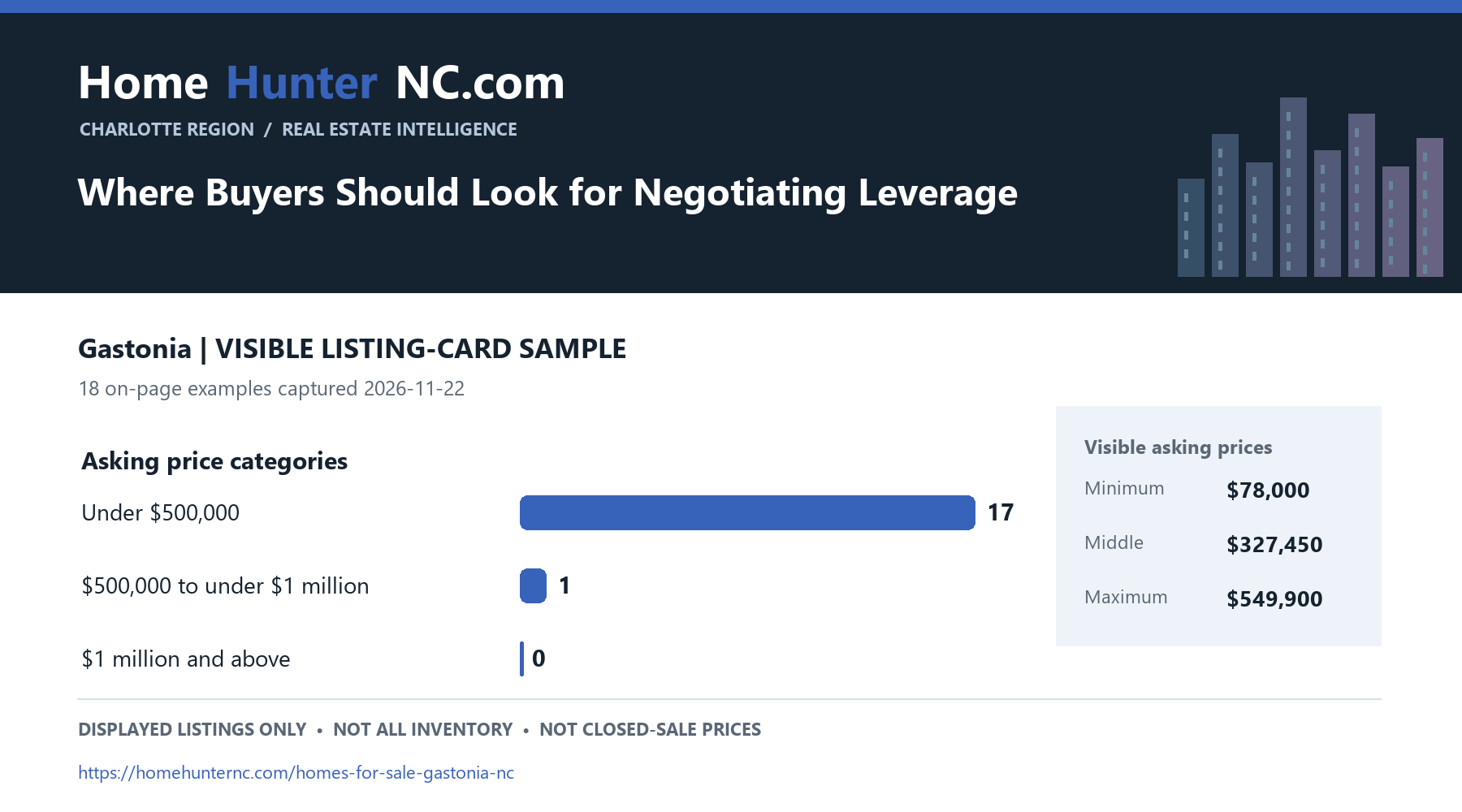
The local data is small. It covers 18 visible listing cards captured from one Gastonia search page on the evening of November 21, 2026 (Eastern). These are asking prices only. They are not full MLS inventory or sold prices, and they don’t represent the market as a whole. They are useful for one purpose: showing how widely sellers’ opening positions vary.
Asking Price Per Square Foot
In this sample, asking prices run from $78,000 to $549,900. Seventeen of the 18 cards are under $500,000, and the median asking price of the visible cards is $327,450. That figure can’t be compared directly with the Charlotte region’s $390,000 median closed price discussed below. One number is what sellers want on one day. The other is what buyers actually paid across 16 counties over a month.
Asking price per square foot shows the spread more clearly. 508 Granite Avenue asks $78,000 for 952 square feet, about $82 per square foot. 4339 Cross Ridge Drive asks $369,900 for 1,416 square feet, about $261. That gap is more than three-fold, roughly 3.2 times. 2018 Baronwood Court, at $195,000 for 1,455 square feet ($134), has the second-lowest figure in the sample. 1031 Laurel Lane is listed at $350,000 for 1,792 square feet ($195).
This comparison is crude. It ignores condition, age, lot size, mechanical systems and exact location. Those factors usually explain most of the spread. A low figure may reflect deferred maintenance, and a high one may reflect a recent renovation. The point that matters legally is simple. An asking price is the seller’s opening position, not an appraisal and not a valuation. Owners have every right to set it. Buyers have every right to verify the property and counter. A low $/sqft figure should prompt questions, not get treated as a bargain. A high one is a claim the seller should be able to support with comparable closed sales.
Before narrowing your search to one property, compare available homes across Gaston County by property type, condition, and location. Use recent closed sales near the candidate property when estimating value; a broader inventory search helps identify alternatives.
The Regional Picture and the Cost of Money
The Canopy Realtor Association’s Charlotte Region Local Market Update for October 2026 (data current November 5, 2026) covers a 16-county NC/SC area. It is not a Gastonia-specific sample. Its October numbers:
- Closed sales fell 16% year over year, to 3,134.
- The median closed price slipped 2.5%, to $390,000.
- Inventory rose 9.6%, to 14,096, which works out to about 4 months of supply.
- New listings fell 3.3% over the same period, so the inventory increase doesn’t come from a flood of new sellers.
- Days on market was 57. The available source material doesn’t say whether that is a mean or a median.
Together, these figures suggest buyers in the region may have more room to negotiate on some properties than they did a year ago. They don’t establish conditions in Gastonia. This article has no days-on-market data for the individual listings above.
Financing is the other constraint. Freddie Mac’s Primary Mortgage Market Survey for November 19, 2026 put the U.S. weekly average 30-year fixed rate at 7.28%. That compares with 7.11% the previous week and 6.26% a year earlier. These are national survey averages, not a rate any particular borrower will be quoted. On a $300,000 loan, principal and interest come to about $1,849 a month at 6.26% and about $2,053 at 7.28%, roughly $204 more each month.
That gap is the financial argument for a correction. When payments rise faster than incomes, sellers who need to sell have to meet buyers closer to what buyers can afford. This is a conditional reading, not a forecast, and it doesn’t imply a 2008-style collapse. On the same date, the Mortgage Bankers Association’s National Delinquency Survey for Q3 2026 reported a 4.42% delinquency rate and foreclosure starts of 0.21%. Those are national loan-performance figures that give background on household strain. They say nothing about distress on any Gastonia street.
Turning Information Into Terms
Price cuts and seller concessions are financially different. Lowering the price reduces the loan principal and every interest payment over the life of the loan. A concession lowers the cash a buyer needs at closing but leaves the loan amount where it was. Which one is worth more depends on how long you plan to hold the property and how much cash you have. Run both scenarios with your lender before you counter.
If a property has been listed for a long time, don’t assume the seller is desperate. Ask why it hasn’t sold. Was it overpriced? Did an inspection turn up problems? Did financing fall through? Your agent can pull the listing history and price changes. The answers tell you whether you have real leverage or the seller has a problem you’d be taking on.
Protect your ability to walk away. North Carolina residential purchases commonly use a due diligence period, and the terms that come with it are negotiable. Its length, fees and how it interacts with inspections, appraisal and financing should be worked out with a licensed agent or a real estate attorney. Ordering a title search and reviewing liens is standard practice on any purchase, whatever the national delinquency numbers say. Waiving protections to make an offer look cleaner works against the inspection work that gives you leverage in the first place.
Use the snapshot to identify which properties to investigate. Then base your offer on closed comparable sales and the actual condition of the house, not on the asking price.
To compare current asking prices yourself, see Gastonia homes for sale on HomeHunterNC.
Listing snapshot captured 2026-11-22T04:20 UTC (about 23:20 EST on November 21, 2026). Figures are asking prices from 18 visible cards on one page, not completed sales. Regional and national data are as of the dates cited. This is not financial or legal advice.

