A young buyer in Gastonia is really dealing with two prices: the price of the house and the price of money. Right now the second one is doing more of the damage. Before running the numbers, separate what each dataset measures. Listing cards, regional closed sales and national mortgage surveys measure different things, and they don’t belong in the same sample.
What the Gastonia snapshot does and doesn’t show
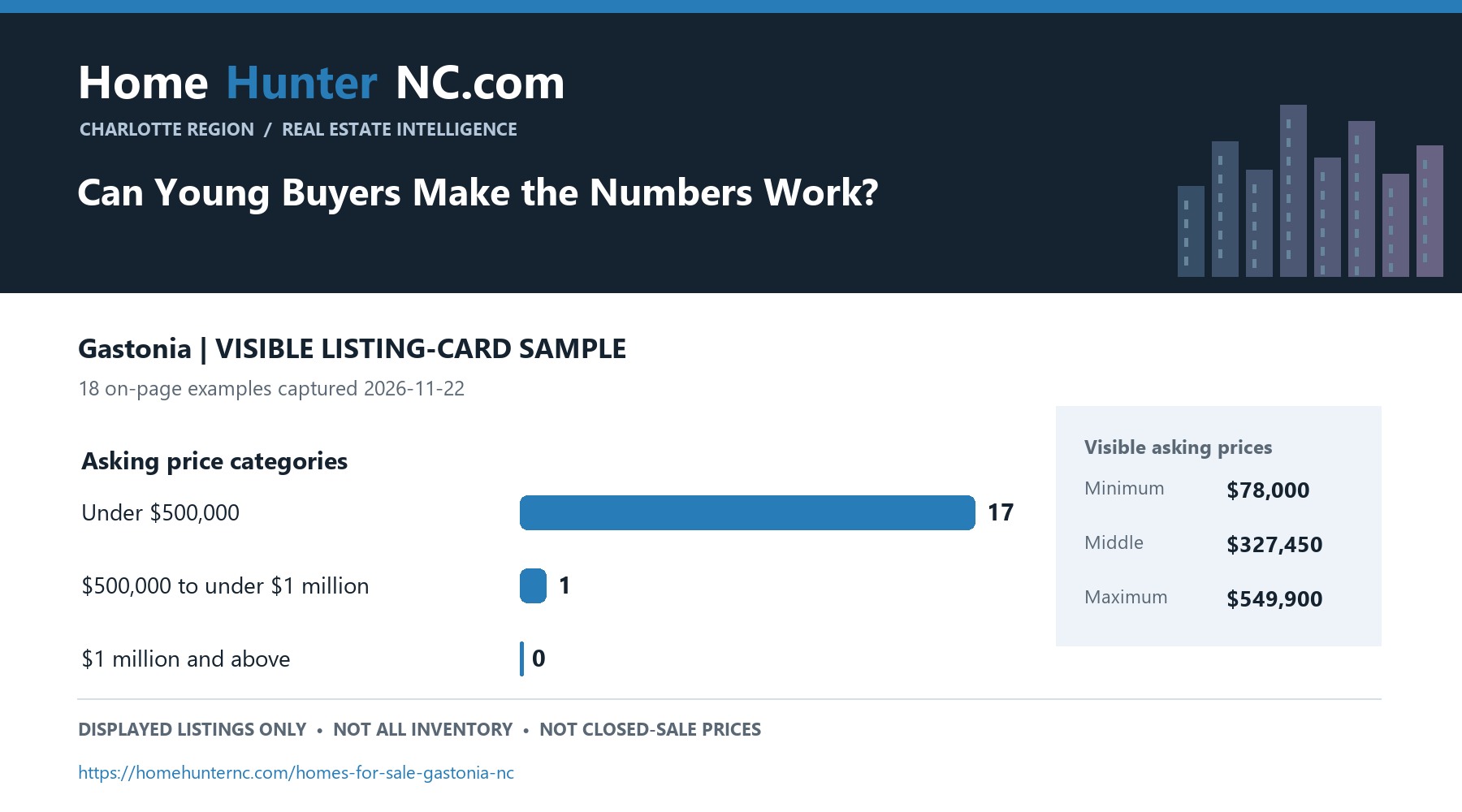
At about 04:21 UTC on November 22, 2026, 18 listing cards were visible on one HomeHunterNC Gastonia search page. This is not the full MLS, and these are not sold prices. Asking prices on those cards ran from $78,000 to $549,900, with a median of $327,450. Seventeen of the 18 asked under $500,000, and none asked $1 million or more. Asking price per square foot ranged from about $82 to $261. That spread is wide enough that the headline price tells a buyer little about what each dollar buys.
The Canopy Realtor Association’s Charlotte Region Local Market Update for October 2026 (data current November 5, 2026) is a different measure. It covers closed sales across a 16-county NC/SC region:
- Median closed sale price: $390,000, down 2.5% year over year
- Closed sales: 3,134, down 16%
- Inventory: 14,096, up 9.6%
- New listings: 4,787, down 3.3%
- Months of supply: 4
- Days on market: 57
The $327,450 Gastonia figure and the $390,000 regional figure can’t be compared directly. One is the median asking price of 18 cards captured at one moment. The other is the median closed price across a 16-county region for a full month. Neither one shows which way Gastonia prices are moving. What the regional data does show is more inventory and fewer closings than a year ago. If that affordability strain persists, regional prices could soften further. That is a conditional reading, not a forecast for any ZIP code and not a prediction of a crash.
Before narrowing your search to one property, compare available homes across Gaston County by property type, condition, and location. Use recent closed sales near the candidate property when estimating value; a broader inventory search helps identify alternatives.
The cost of capital, priced out
The Freddie Mac Primary Mortgage Market Survey for November 19, 2026, put the U.S. average 30-year fixed rate at 7.28%. That compares with 7.11% the prior week and 6.26% a year earlier. The 15-year average was 6.66%. These are national weekly survey averages, not a local rate or a personal quote.
To illustrate, take the $327,450 snapshot median as the purchase price, with a 7.28% rate and a 30-year term:
| 20% down | 5% down | |
|---|---|---|
| Down payment | $65,490 | $16,372.50 |
| Loan amount | $261,960 | $311,077.50 |
| Monthly principal & interest | ≈ $1,792 | ≈ $2,128 |
These figures exclude property taxes, homeowners insurance, HOA dues and private mortgage insurance (PMI). With less than 20% down on a conventional loan, PMI generally applies. Its cost depends on credit score and loan-to-value ratio, so get a lender quote rather than relying on a rule of thumb.
At a year-ago rate of 6.26%, the same $261,960 loan would carry roughly $1,615 a month in principal and interest. The rate change alone adds about $178 a month, with no change in the house price. For a rate-sensitive buyer, that is the real affordability story.
Cash to close (illustrative): Assume closing costs of 2% to 5% of the loan amount. That range is an assumption for illustration, not a sourced Gastonia figure. Your lender’s Loan Estimate will give the actual number.
- 20% down: $5,239 to $13,098 in closing costs, for roughly $70,729 to $78,588 total
- 5% down: $6,222 to $15,554 in closing costs, for roughly $22,594 to $31,926 total
Earnest money is not an extra cost on top of these totals. It is usually credited toward the buyer’s down payment or cash due at closing.
The Mortgage Bankers Association’s Q3 2026 National Delinquency Survey (November 19, 2026) reported a 4.42% delinquency rate and 0.21% foreclosure starts. These are national figures and say nothing about Gastonia specifically. The practical point still holds: a payment that only works under ideal conditions leaves no room for a job change, a repair or a property tax reassessment.
Due diligence fee vs. earnest money: the distinction that matters
North Carolina’s standard residential purchase contract creates two separate payments that buyers often confuse:
- Due diligence fee: typically paid directly to the seller in exchange for the right to investigate the property and terminate during the due diligence period.
- Earnest money deposit: typically held in escrow, and it can be treated differently depending on when and why the buyer terminates.
How each payment is credited, refunded or forfeited depends on the contract’s terms and deadlines. Read the executed contract, and consult a licensed North Carolina real estate attorney or broker before committing either sum.
For a buyer working with little capital, this is where risk gets priced. Money spent on due diligence is money at stake before you know what the house needs. Inspection costs and repair risk can weigh more heavily on lower-priced homes, where a single major system failure can be a large share of the purchase price. No listing card shows a home’s condition. An inspection does.
The numbers can work for a young buyer, but only with the cash reserves, the rate assumption and the contract terms set before the offer goes in, not after.
Listing snapshot captured 2026-11-22, 04:20–04:21 UTC: 18 visible cards on one search page, not the full MLS, not sold prices. Regional data: Canopy, October 2026, current as of November 5, 2026. National rate and delinquency data: Freddie Mac and MBA, both dated November 19, 2026.

