Anyone pricing a Gastonia house this winter is working with three kinds of numbers that are easy to blur together. One is what sellers asked on a single night. Another is what buyers actually paid across a 16-county region. The third is what mortgage money costs nationally. Each was collected on a different date and answers a different question. Read separately, they tell you more than any combined story can.
What One Search Page Can and Cannot Show
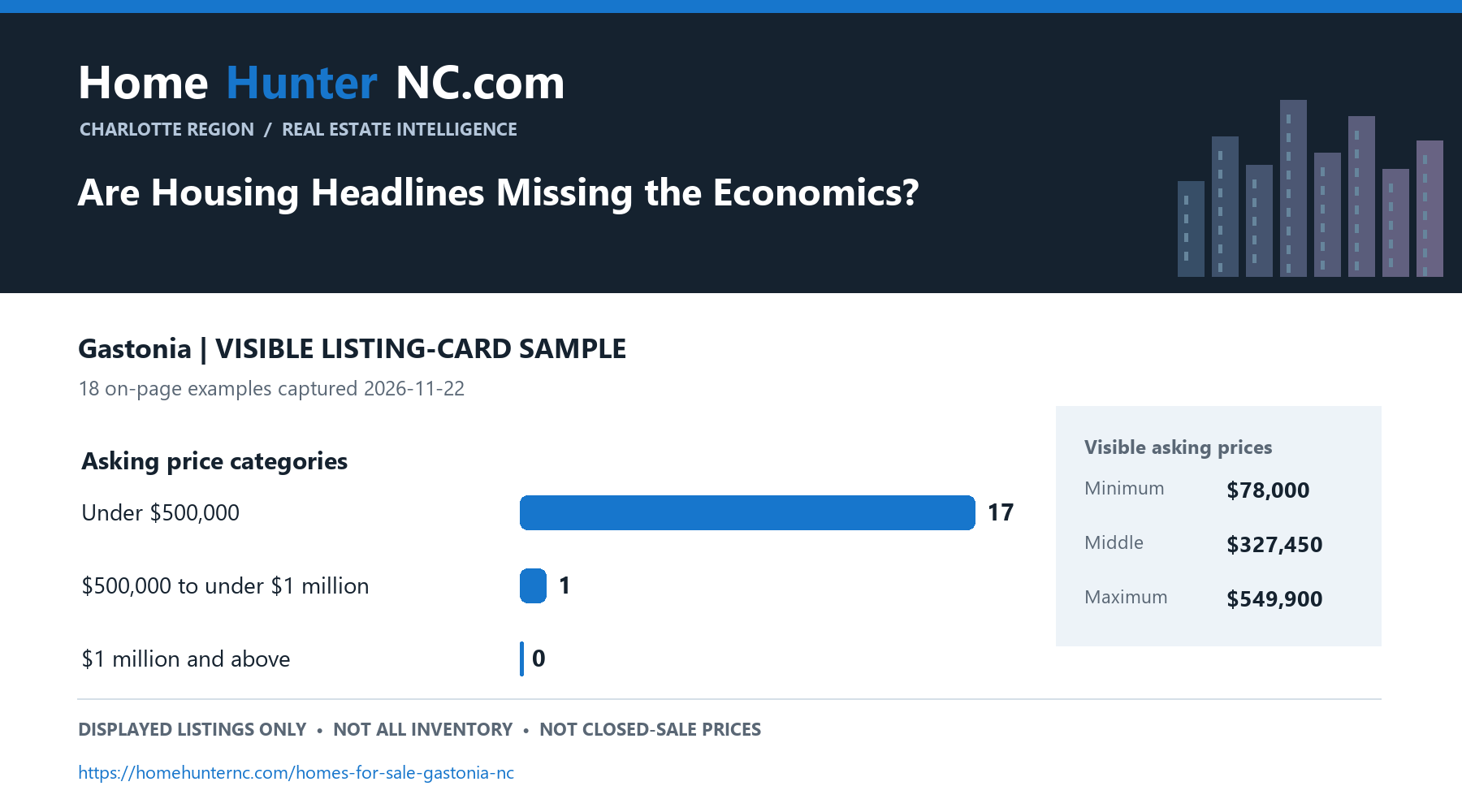
On Nov. 21, 2026, 18 listing cards were visible on one Gastonia search page. These are asking prices, not sales. They are not a full MLS count or a representative sample. Within those limits, the spread is still useful. Asking prices ran from $78,000 for 508 Granite Avenue (952 square feet) to $549,900 for 503 Bridgestone Court (2,688 square feet). The median of the 18 cards was $327,450. Seventeen were under $500,000, one was between $500,000 and $1 million, and none were higher.
Price per square foot tells you more. 2018 Baronwood Court asked $195,000 for 1,455 square feet, about $134 a foot. 4339 Cross Ridge Drive asked $369,900 for 1,416 square feet, about $261. The two houses are nearly the same size, but one asks almost twice as much per foot. Condition, lot, age or location may explain the gap. So may an optimistic seller. Only a closing will settle it.
The legal difference matters here. An asking price invites offers and binds no one. A closed price is a completed, recorded transfer between a willing buyer and a willing seller. For buyers, the wide spread in asking prices means real choice. For sellers, a price above what buyers will pay gets tested by time on the market, not by argument.
Before narrowing your search to one property, compare available homes across Gaston County by property type, condition, and location. Use recent closed sales near the candidate property when estimating value; a broader inventory search helps identify alternatives.
The Regional Record: Slower Absorption, Softer Prices
The Canopy Realtor Association’s October 2026 Local Market Update for the Charlotte Region has data current as of Nov. 5, 2026. It covers 16 counties in North and South Carolina and is not specific to Gastonia. October closed sales fell 16% year over year to 3,134. The median closed price was $390,000, down 2.5%.
Inventory rose 9.6% to 14,096 homes, but sellers did not rush in. New listings fell 3.3% to 4,787. Homes are piling up because fewer are selling. The region showed 4 months’ supply and 57 days on market, which gives buyers time to compare and negotiate.
Financing costs are likely a contributing factor. Freddie Mac’s Primary Mortgage Market Survey, released Nov. 19, 2026, put the national average 30-year fixed rate at 7.28%. That was up from 7.11% a week earlier and 6.26% a year earlier. The 15-year rate averaged 6.66%. These are U.S. survey averages, not Charlotte figures and not anyone’s loan quote.
Here is an illustrative calculation, not a quote. A $327,450 purchase with 10% down leaves a $294,705 loan. At 7.28% over 30 years, principal and interest come to about $2,016 a month. At last year’s 6.26%, the same loan costs about $1,816. The rate change alone adds roughly $200 a month. That is before property taxes, homeowners insurance or mortgage insurance, all of which raise the real payment.
None of this tells you which way Gastonia prices are moving. Don’t compare the $327,450 card median with Canopy’s $390,000 closed median as proof that Gastonia is cheaper or falling. The first is one night’s asking prices. The second is a month of closed sales across the region.
Correction Is Not Collapse
One reasonable reading of the evidence is a possibility, not a forecast. Rates are about a point higher than a year ago. Regional sales are down 16%, the regional median is down 2.5% and inventory is building. That affordability pressure could push prices lower still. This is not proven at the Gastonia or ZIP level, and it does not imply a 2008-style crash.
National credit data helps draw that line. The Mortgage Bankers Association’s Q3 2026 National Delinquency Survey, released Nov. 19, 2026, reported a 4.42% delinquency rate and foreclosure starts of 0.21%. Both are national loan-performance measures, not local foreclosure counts. A delinquent loan is a missed payment, not a lost house. The 2008 bust was driven by forced selling at scale. A correction is a negotiation between owners who can wait and buyers who can walk away. These national figures are context, not a verdict on Gastonia.
For developers, the supply side deserves the same discipline. A widely held view among economists is that restrictive zoning and slow approvals limit how much housing gets built. When supply can’t respond, more of any change in demand shows up in the prices of existing homes. That is a general view, not a finding about Gastonia’s rules. The practical point is narrower. The $82 to $261 per-square-foot range on the Nov. 21 cards gives a rough picture of the asking prices new product would compete against. A pro forma still belongs on recorded closed comps.
For buyers and sellers alike, price against what has closed, not what is advertised. With the region at four months’ supply, pricing correctly matters more than listing first.
See the search page: Gastonia homes for sale.
Listing-card snapshot captured 2026-11-21 at about 23:20 ET (2026-11-22T04:20Z). These are 18 asking prices on one search page, not completed sales, a full MLS count or a representative sample. Canopy data is current as of Nov. 5, 2026. The Freddie Mac and MBA figures were released Nov. 19, 2026.

